Range Repair
One Viking Burner Sparks Without Lighting: Cap, Ports, Electrode
When one Viking sealed burner keeps sparking and never catches, the gas valve is rarely to blame. What the clicking says, and three checks to make before booking anything.
- Published
- Read time
- 4 min
- Appliance
- Range Repair
- Checked by
- Hollis Yamada
- Bench role
- Service technician — refrigeration and cooking
- At the bench
- 21 years in the trade
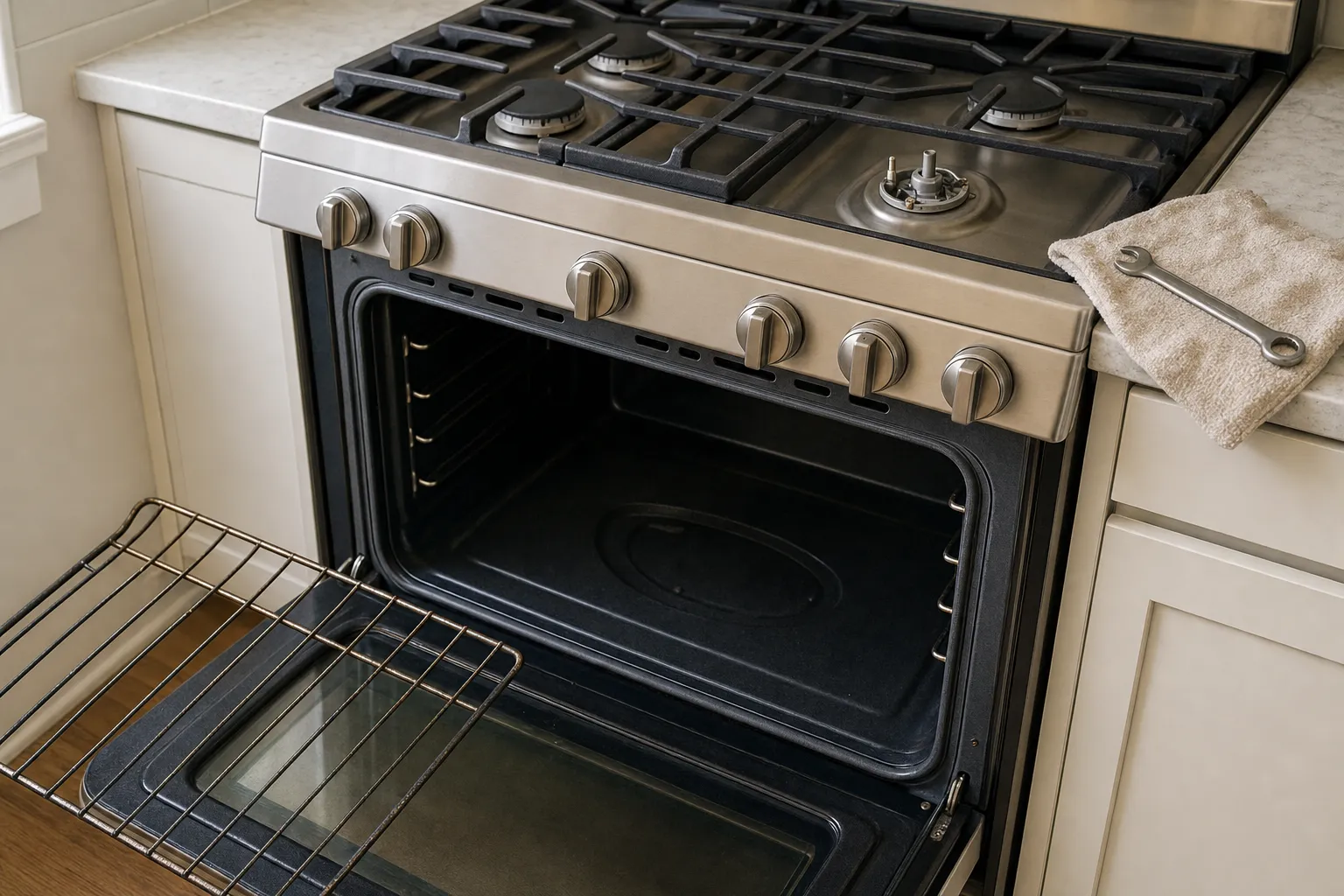
Endless clicking from one burner that never catches is a frequent Redmond call, and a frequently misread one. The noise sounds like a failure, so owners assume the ignition system is dead. It is the opposite: the clicking is proof the ignition system is alive and working. Something is stopping the spark from doing its job at the burner itself.
That distinction matters because the parts sit at opposite ends of the price range. A spark module is an expensive component. A burner cap sitting a millimetre out of alignment costs nothing at all.
What the clicking actually proves
Every time you hear a click, the spark module has successfully generated high-voltage current and delivered it to the electrode. The circuit — control knob switch, module, harness, electrode — is intact. If any part of that chain were open, you would get silence, not clicking.
So the fault sits in one of two places. Either the spark is being generated but is not jumping to the right spot, or gas is not arriving at the burner head in a mixture that will catch when it does.
On Viking sealed burners the spark has to jump a small, specific gap between the electrode tip and the burner base. That gap is engineered, not approximate. Move the burner cap a fraction off its seat and the flame port that should be catching the spark is no longer under it. The range keeps trying. Nothing lights.
The three checks worth doing yourself
Start with the burner cap. Lift it off, look at the seat, and put it back down deliberately — it should drop into a defined position, not float. Caps get lifted for cleaning and dropped back rotated a few degrees, and a few degrees is enough. This single check resolves a meaningful share of the calls we would otherwise be dispatched for.
Second, look at the burner ports. Boil-over from a pot of pasta runs into the ports, dries into a glaze and blocks the gas path immediately around the electrode. The rest of the burner may light normally, which is why people miss it — the ring lights everywhere except the one spot the spark reaches. A stiff brush and a straightened paperclip clears it. Never drill the ports.
Third, dry everything. A burner that has been cleaned recently, or one that sits next to a sink and catches spray, will short the spark to the nearest wet path instead of jumping the intended gap. A range that clicks for twenty minutes after a kitchen clean and then behaves normally was never faulty.
When it is the electrode
If the cap seats correctly, the ports are clear and the burner is bone dry, the next suspect is the electrode itself. There are two failure modes and they look different.
A cracked ceramic insulator lets the spark leak to the burner body along the crack rather than jumping the gap. In a dark kitchen you can often see it — the spark appears at the base of the electrode instead of the tip. This is a replacement, and it is a modest one.
A bent or eroded electrode has simply drifted out of its gap over the years. The tip erodes microscopically with every spark, and after a decade of daily use the gap is wider than the module can reliably bridge. It gets worse in the cold, which is why these calls cluster in Redmond between November and February.
Either way this is a discrete part, not a control board, and it does not turn a working range into a scrapped one.
When the clicking never stops
There is one version of this fault that is genuinely urgent, and it is worth separating from everything above.
If the range clicks continuously — including when every knob is at zero, or when another burner is already lit and running — that is not a burner problem. That is the spark module stuck in re-ignition, usually because a switch contact behind one of the knobs has failed closed or moisture has bridged the module’s input.
The reason it matters is that a module stuck in re-ignition sparks under every burner, lit or not, and the switch fault behind it rarely improves on its own. It is not a slow-burn problem to schedule for next month. Switch the range off at its breaker and book it.
The oven below is a different system. On Viking’s self-clean gas ranges the oven burner lights by spark too, but a failed light there ends in an ignition lockout rather than endless clicking, and it has its own check.
What we do on arrival
The diagnostic runs in a fixed order because the cheap causes are also the common ones. Cap seating and port condition first, visually. Then the electrode gap, measured, and the ceramic checked under light. Then spark energy at the electrode with the module under load, which tells us whether the module is delivering full output or has weakened. Only after all of that does anything get ordered.
A cleaned burner, a cap put back where it belongs, or one electrode: that is how the majority of these visits finish. The expensive answer — a failed spark module — is real, but it is the last thing we conclude, not the first.
Common follow-ups
Can the other burners be used while one keeps clicking?
Only briefly. A spark module stuck in continuous re-ignition keeps firing every electrode on the range, including under a pan that is already lit, and while the faulty burner's knob is on, gas flows there unlit. Turn the faulty burner fully off, and if the clicking carries on with every knob at zero, cut the range's power at the breaker and leave it there until a technician has been out.
Why will a match light it when the spark will not?
Because the gas is arriving and the burner is willing — only the spark is failing to land in the right place. That points at electrode position, a cracked ceramic insulator or a wet burner cap seat, not at the valve or the regulator.
How long should a Viking burner take to light?
Within a few clicks. When a burner needs a long run of sparks before it catches, the cap, the ports or the electrode have already started to drift, and that is the moment to clean and reseat them, before the burner stops lighting at all.